
Board feet measure volume, not board length
A board foot is based on 144 cubic inches of lumber. Picture a piece 1 inch thick, 12 inches wide and 12 inches long. It contains one geometric board foot. A narrower, longer piece can contain the same amount of wood.
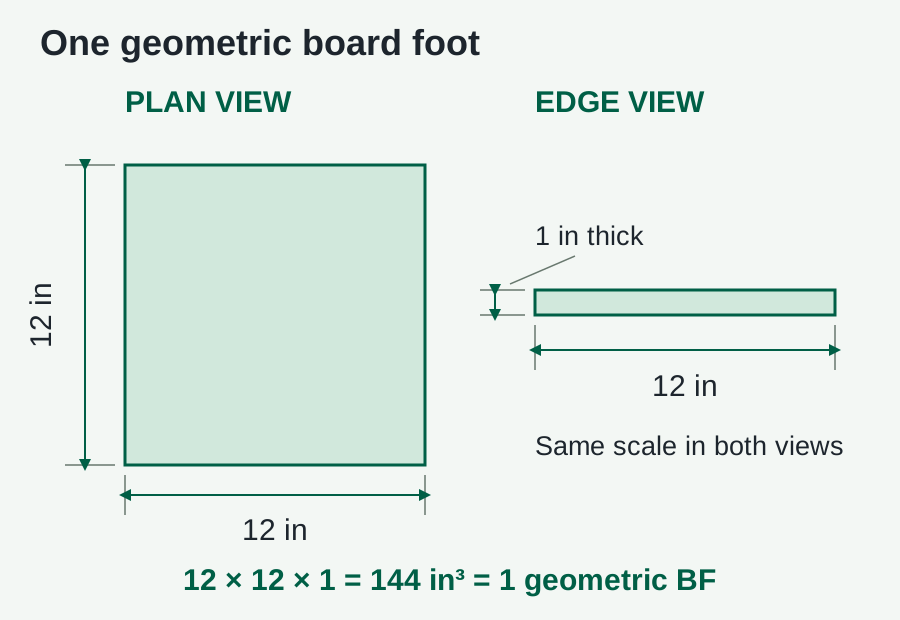
A square foot measures area, and a linear foot measures length. Neither gives a board-foot quantity without more information. One square foot of wood is one geometric BF at 1 inch thick, but two geometric BF at 2 inches thick.
Before measuring, decide whether you need physical volume or a trade tally. Actual dimensions give geometric volume. Nominal softwood board measure uses size labels instead. Hardwood transactions may use specific thickness, measurement and rounding conventions. Keep that basis with the total rather than assuming every BF figure describes physical volume.
The board-foot formula: choose the right length unit
The board-foot calculator’s regular U.S. mode takes thickness and width in inches but length in feet. Use the following formula for matching boards.
Scroll the table horizontally to see all columns.
| Variable | What to enter | Unit |
|---|---|---|
| T | Board thickness | inches |
| W | Board width | inches |
| L | Board length | feet |
| N | Number of matching boards | whole boards, at least 1 |
| BF | Calculated lumber quantity | board feet |
The divisor comes from converting feet of length to inches: T × W × (12 × L) ÷ 144 simplifies to T × W × L ÷ 12. If you already have all three dimensions in inches, divide by 144 instead.
Do not put a 96-inch length into the regular Length field as 96. Enter 8 feet. In the finished-part mode, the length field uses inches, so 96 is appropriate there. The field unit determines which number belongs in the form.
Enter a measured board in the calculator
The detail page opens with example inputs and an example result. Those values are a demonstration. Replace them with your measurements before using the result for your project.
- Under Calculation, choose Board or matching parts. Under Input units, choose U.S. customary or Metric.
- Choose Actual for measured physical dimensions, or Nominal when checking a nominal softwood tally. This control records the basis; it does not change the dimension numbers.
- Enter thickness, width and length in the units shown beside the fields. Enter decimal values, such as 0.75 for 3/4 inch. Enter the number of boards as a positive whole number.
- Select Calculate. Read the per-board result for the first group and the total for all groups. If you change a value, calculate again to update the result.
- Use Reset to restore and recalculate the example on a detail page. The homepage quick calculator instead restores its inputs and clears the result.
Measure four matching boards
Inputs
- Calculation: Board or matching parts; Input units: U.S. customary; Dimension basis: Actual.
- Measured thickness 1 in, width 6 in, length 8 ft; Number of boards: 4.
Calculation
- One board: 1 × 6 × 8 ÷ 12 = 4 BF.
- Four boards: 4 BF per board × 4 boards = 16 BF.
Calculator results
- Per board in first group
- 4 BF
- Four-board total
- 16 BF
The first output is 4 BF per board in the first group. The total is 16 BF. Because the inputs are actual measurements, this total describes physical wood volume.
Enter 8 feet 6 inches as 8.5 feet
Inputs
- Calculation: Board or matching parts; Input units: U.S. customary; Dimension basis: Actual.
- Three boards, each 0.75 in thick × 5.5 in wide × 8 ft 6 in long. Enter Length as 8.5 ft.
Calculation
- Convert the extra inches: 6 ÷ 12 = 0.5 ft. Total length = 8 + 0.5 = 8.5 ft.
- One board: 0.75 × 5.5 × 8.5 ÷ 12 = 187/64 = 2.921875 BF.
- Three boards: (187/64) × 3 = 561/64 = 8.765625 BF.
Calculator results
- Per board
- 2.922 BF
- Three-board total
- 8.766 BF
The calculator displays 2.922 BF per board and 8.766 BF total. Keep the unrounded per-board value when checking the total. Typing 8.6 would mean 8 feet 7.2 inches, not 8 feet 6 inches.
Scroll the table horizontally to see all columns.
| Mode | Thickness and width | Length | Other limits |
|---|---|---|---|
| Regular U.S. board mode | inches; at least 0.001 | feet; at least 0.001 | Board count is a whole number ≥ 1. |
| Regular metric board mode | mm; at least 0.0254 | meters; at least 0.0003048 | Every board group uses the same units. |
| Finished-part U.S. mode | inches; at least 0.001 | inches; at least 0.001 | Allowances may be zero. |
| Finished-part metric mode | mm; at least 0.0254 | mm; at least 0.0254 | Allowances use mm as well. |
These are the form’s accepted minimums, not a claim about measurement accuracy. Blank required fields, zero dimensions and fractional board counts are invalid. Measure to a precision appropriate for the job rather than adding digits your measuring tool cannot support.
Total a mixed list one size group at a time
A size group contains boards with the same thickness, width and length. Calculate that group’s quantity, multiply by its board count, and add the group totals. Do not average the dimensions before multiplying: the product of average dimensions need not equal the total volume.
Scroll the table horizontally to see all columns.
| Group | Thickness × width × length | Count | BF per board | Group BF |
|---|---|---|---|---|
| A | 1 in × 6 in × 8 ft | 4 | 4 | 16 |
| B | 1 in × 8 in × 9 ft | 2 | 6 | 12 |
| Total | Two separate sizes | 6 | — | 28 |
Add two lumber groups without averaging their dimensions
Inputs
- Calculation: Board or matching parts; Input units: U.S. customary; Dimension basis: Actual.
- Group A: four boards, each 1 in × 6 in × 8 ft.
- Select Add board group. Group B: two boards, each 1 in × 8 in × 9 ft.
Calculation
- Group A, per board: 1 × 6 × 8 ÷ 12 = 4 BF. Group A total: 4 × 4 = 16 BF.
- Group B, per board: 1 × 8 × 9 ÷ 12 = 6 BF. Group B total: 6 × 2 = 12 BF.
- Add group totals: 16 + 12 = 28 BF.
Calculator results
- Per board in first group
- 4 BF
- Mixed-list total
- 28 BF
The total covers all six boards. The per-board output still describes the first group: 4 BF. It is neither the second group’s value nor an average of the entire list.
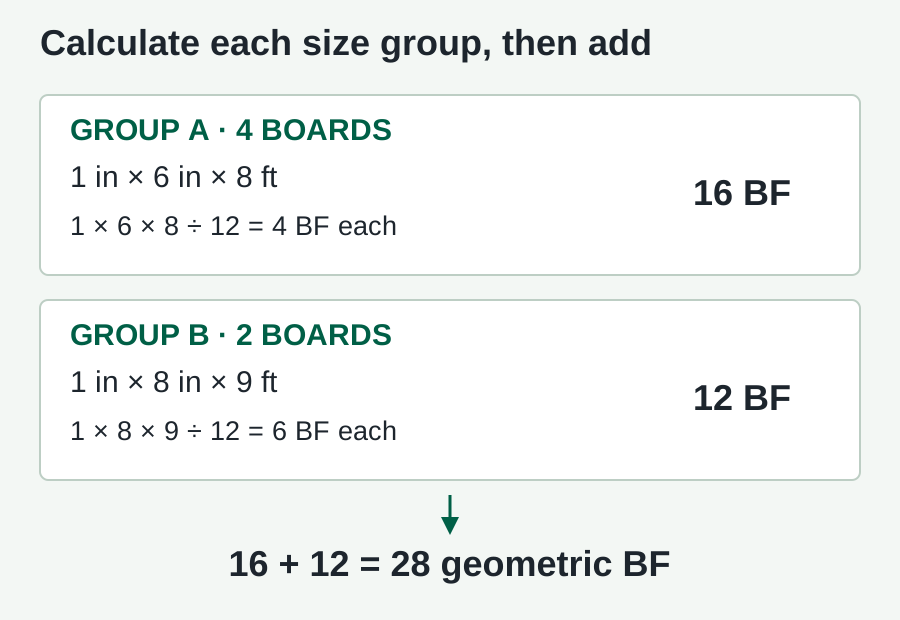
Use Add board group for each additional size. All groups share the input-unit setting and dimension basis. If part of a list is nominal board measure and the rest is measured volume, keep separate totals until the quantities are expressed on a consistent basis.
Add total milling allowances to finished dimensions
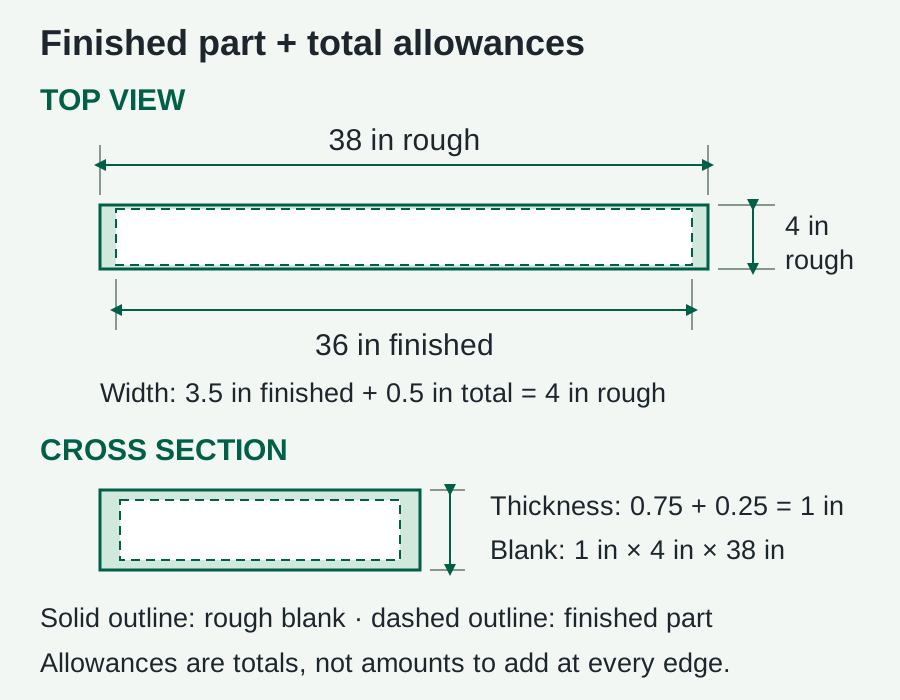
Finished part to rough stock starts with the part you want after machining. You then add extra thickness, width and length for your process. Each allowance is a total increase in that dimension: a 0.25-inch thickness allowance adds 0.25 inch once, not to each face.
- Choose Finished part to rough stock. In U.S. mode, all finished dimensions and allowances use inches. In metric mode, all six fields use millimeters.
- Enter the finished thickness, width and length, followed by the whole-number part count.
- Enter one total allowance for each dimension. Choose allowances from your stock condition and machining plan; the example is not a universal milling recommendation.
- Calculate the blank volume, then check the rough dimensions against available stock and your cutting layout.
Allow for milling six finished parts
Inputs
- Calculation: Finished part to rough stock; Input units: U.S. customary; Number of boards: 6.
- Finished thickness 0.75 in; finished width 3.5 in; finished length 36 in.
- Total thickness allowance 0.25 in; total width allowance 0.5 in; total length allowance 2 in.
Calculation
- Rough thickness = 0.75 + 0.25 = 1 in.
- Rough width = 3.5 + 0.5 = 4 in. Rough length = 36 + 2 = 38 in.
- One blank = 1 × 4 × 38 ÷ 144 = 19/18 = 1.055555… BF.
- Six blanks = (19/18) × 6 = 19/3 = 6.333333… BF.
Calculator results
- Per rough blank
- 1.056 BF
- Six-blank total
- 6.333 BF
The displayed answers are 1.056 BF per blank and 6.333 BF total. Do not multiply the rounded 1.056 by six; that would produce 6.336 BF. The model estimates rectangular blank volume, not whether a particular stock board can supply the parts.
Blank volume does not include kerf between separate blanks, a defect-cutting plan or an additional purchasing overage. Account for those separately where needed. Do not add a milling allowance again if it is already included in the dimensions on your cut list.
Use metric input without changing the output unit
The exact conversions are 25.4 mm per inch and 0.3048 m per foot. Metric board mode asks for thickness and width in millimeters and length in meters. The result remains BF. Finished-part mode is different: its finished length and length allowance are both in millimeters.
Check the four-board example with metric measurements
Inputs
- Calculation: Board or matching parts; Input units: Metric; Dimension basis: Actual.
- Thickness 25.4 mm; width 152.4 mm; length 2.4384 m; Number of boards: 4.
Calculation
- Thickness: 25.4 ÷ 25.4 = 1 in. Width: 152.4 ÷ 25.4 = 6 in.
- Length: 2.4384 ÷ 0.3048 = 8 ft.
- Group quantity: 1 × 6 × 8 × 4 ÷ 12 = 16 BF.
Calculator results
- Per board
- 4 BF
- Four-board total
- 16 BF
The result matches the U.S. customary example: 4 BF per board and 16 BF total. Metric mode changes the dimension units, not the output unit or the physical amount of wood.
Switching Input units converts dimensions already entered in the form. Do not then convert those same values manually a second time. If you change the calculation mode, read the length field’s unit again before entering a value.
Keep a geometric total separate from a seller’s tally
Selecting Actual does not turn an entered 2×4 into 1.5×3.5. The calculator multiplies the numbers you supply. For physical volume, enter the thickness and width you measured. For a nominal softwood tally, enter the stated nominal dimensions and keep that trade basis explicit.
For hardwood, ask how the seller determines thickness, width, length and any rounding. A 4/4 designation identifies a nominal 1-inch thickness; it does not guarantee a finished thickness after surfacing. The geometric tool does not silently apply surface-measure or invoice-rounding rules.
Convert or price a result only after checking its basis
Scroll the table horizontally to see all columns.
| Next task | Additional information | Condition |
|---|---|---|
| Find physical cubic volume | Geometric BF | Divide by 12 for ft³. Do not use nominal softwood board measure. |
| Find linear feet | Fixed thickness and width | Use one cross section and the same quantity basis. |
| Add purchasing overage | User-selected percentage | Apply only to a net requirement that does not already include it. |
| Check a quoted subtotal | Price per payable BF | Confirm the seller’s quantity and pricing basis. |
Convert the measured mixed list to cubic feet
Inputs
- Open Board feet to cubic feet. Select Board feet to cubic feet and the Actual basis.
- Enter 28 geometric BF from the mixed-list example.
Calculation
- Cubic feet = 28 ÷ 12 = 7/3 = 2.333333… ft³.
- Cubic meters = (7/3) × 0.028316846592 = 0.066072642048 m³.
Calculator results
- Physical volume
- 2.333 ft³
- Physical volume
- 0.066 m³
The outputs display 2.333 ft³ and 0.066 m³. Convert the unrounded quantity when continuing a calculation. A nominal softwood tally cannot be treated as this physical volume.
Find a length for one fixed cross section
Inputs
- Open Board feet and linear feet. Select Board feet to linear feet and the Actual basis.
- Board feet: 18; actual thickness: 0.75 in; actual width: 6 in.
Calculation
- Cross-sectional area = 0.75 × 6 = 4.5 in².
- Linear feet = 18 × 12 ÷ 4.5 = 48 LF.
Calculator results
- Length at this cross section
- 48 LF
The 18 BF represents 48 linear feet only at this cross section. It does not specify how many separate boards or usable part lengths are available. A mixed list with different cross sections has no single length conversion.
Add a separate purchasing allowance
Inputs
- Open Lumber waste allowance. Net requirement: 28 BF on a consistent dimension basis.
- User-selected overage: 12.5%. This is an illustration, not a recommended waste rate.
Calculation
- Extra material = 28 × 12.5 ÷ 100 = 3.5 BF.
- Gross requirement = 28 + 3.5 = 31.5 BF.
Calculator results
- Extra material
- 3.5 BF
- Requirement including overage
- 31.5 BF
The result adds an allowance to the net quantity. It does not estimate recovery yield or select a waste rate. Use it only when that extra quantity has not already been included in your requirement.
Adding overage and recovering usable parts are different operations. An overage multiplies net need by 1 plus the chosen percentage. A yield calculation divides usable need by the expected recovery fraction. Do not substitute one percentage method for the other.
Check a material subtotal against a confirmed quote
Inputs
- Open Board-foot material cost. Payable quantity confirmed with the seller: 28 BF.
- Quoted price on that same basis: $6.00 per BF. This is an example price, not a market quote.
Calculation
- Material subtotal = payable board feet × price per board foot.
- 28 × $6.00 = $168.00.
Calculator results
- Material subtotal
- $168.00
The calculator shows $168.00 before tax, delivery or other charges. The measured total from a project list is payable only if it matches the seller’s tally basis; confirm that basis before using it in a quote.
Keep intermediate values and round the final answer
Numeric outputs display at most three decimal places, without unnecessary trailing zeros. Currency outputs display cents. The calculation retains intermediate precision: that is why the six-blank total is 6.333 BF rather than six times the displayed 1.056 BF.
For a hand check, keep fractions or enough intermediate digits until the final result. For example, retain 19/18 BF per rough blank and multiply by six before rounding. Display precision does not make your measurement more accurate or establish a supplier’s tally rule.
Questions that often change the answer
Can I use a plywood sheet in the board-foot formula?
Yes, actual rectangular sheet dimensions can describe geometric volume. That result does not tell you how many sheets a project’s parts require. Use the sheet-yield tool for its uniform rectangular layout, and check usable sheet dimensions and grain orientation.
Why does the first output not change when I add another board size?
It reports the volume of one board in the first group. The combined total includes all groups. Read the labels rather than treating the first output as the average board volume.
Does a board-foot total prove I have enough stock?
No. Volume cannot establish that each part fits a board’s width or length. Check grain, defects, machining allowance and the cutting layout as well as the total quantity.
Why is my lumberyard’s quantity different?
Compare the dimension basis and the seller’s thickness, width, length and rounding conventions first. A trade tally and measured physical volume can differ even when both calculations follow their stated methods.
Take a checked quantity into your purchasing plan
Record the units and basis next to the quantity. Calculate each size group, keep unrounded intermediate values and add allowances only where your plan needs them. Before buying, confirm that the available boards fit the parts and that the quoted price applies to the same kind of quantity.